
Deficit Learning: Rise of the Just-in-Time Situational Salesperson
The content outlines Corporate Visions' growth programs and targeted solutions designed to address key sales priorities such as acquiring and retaining customers, creating winnable pipelines, improving win rates, protecting profit margins, managing performance, and evolving sales methodologies through precision skills assessments, sales training, messaging, leadership coaching, and buyer insights.
Growth Programs

Your Growth Priorities
Pick the priority you need to fix first and get a clear starting point.
Targeted Solutions
Solutions and such do some things and some other things here Maecenas sed diam eget risus varius blandit sit amet non magna. Aenean lacinia bibendum nulla.
Precision Skills\ \ Assessments

Not Sure Where to Start?
Learn more about our targeted solutions and see what fits the gap you’re seeing.
Who We Serve
Overview
You’re measured on different outcomes—but your success depends on the same buyer decisions. This is where you find the programs and proof built for your goals.
Choose your role to see what that looks like in practice.
Role-Based Solutions
Find the solutions that map to your responsibilities—and the outcomes you’re expected to deliver.

Case Studies
See how revenue teams like yours use buyer evidence to win more—and keep more.
Approach
Community
Emblaze Community
Get perspective—and pressure-test your plans with peers.
Emblaze Resources
Stop guessing. Get the research and tools members actually use.
Pressure-Test Your Strategies
and Fine-Tune Your Approaches
Get the Evidence to Build Stronger Teams
Rethink how you drive growth. Bring your toughest questions. Leave with clearer decisions.
Resources
Overview
When teams rely on opinions, content gets noisy and inconsistent. Our resources are grounded in buyer evidence—so you can sharpen decisions, messaging, and execution.
Find insights, articles, webinars, and more evidence-backed resources to grow revenue.

Deficit Learning and Development: Enable Sellers When They're Ready to Learn
Tim Riesterer /
October 12, 2026 /
Sales Enablement
Traditional enablement programs run on the flawed assumption that you can deliver training on a schedule and sellers will remember what they need, when they need it. But that’s rarely the case.
Too many sales training programs fail because the skills they deliver arrive before sellers need them, so sellers never use them. Deficit Learning is a Corporate Visions learning and development concept that addresses that timing problem directly.
Think about the last time you needed to change a flat tire.
You probably didn’t remember the steps from instructions you read when you bought the car. You learned on the shoulder of a road, in the rain, because the car wasn’t going anywhere until you did.
Sellers face that same flat-tire moment constantly. New stakeholders enter the picture. A competitor starts circling. And when these high-pressure moments arise, you can’t expect sellers to remember that one tactic you showed them in a workshop during kickoff eight months ago.
Your sellers are in a deficit. The good news is that’s when they learn best.
What Is Deficit Learning?
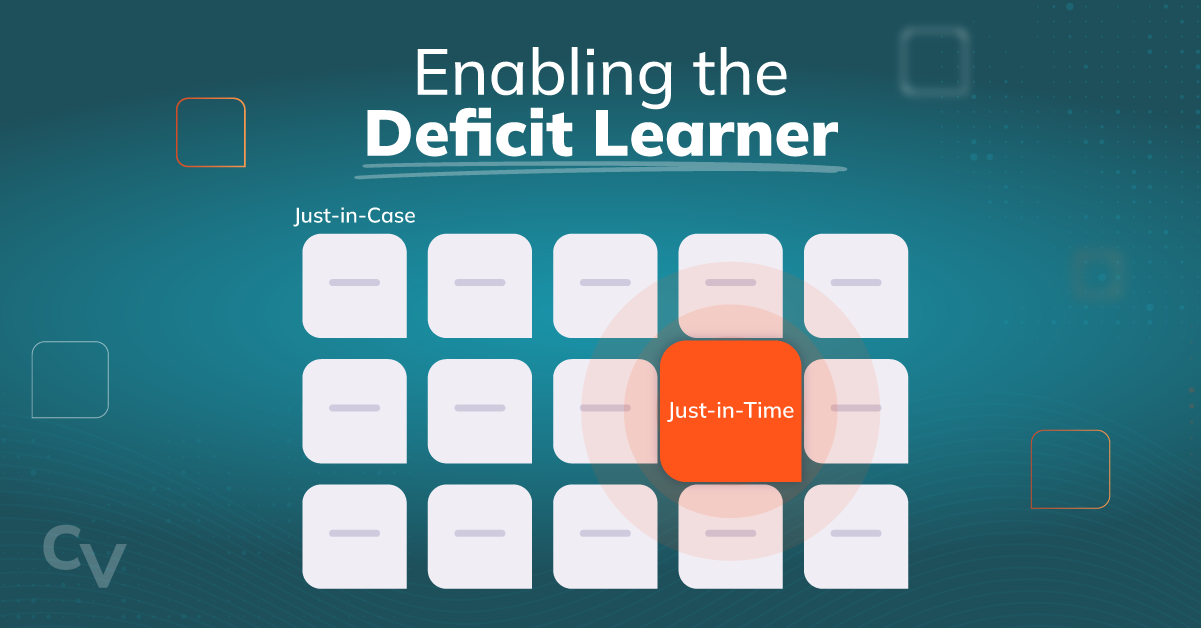
Deficit Learning describes the conditions under which sellers are primed to absorb and apply new skills: the moment a knowledge gap demands it. It’s a core behavioral concept behind just-in-time enablement, because sellers retain and apply training when it arrives at the moment of need, not weeks before or months after.
The Forgetting Curve shows why timing carries so much weight. People forget most of what they learn within a week without reinforcement, and only 1 to 2 percent of that training knowledge shows up in on-the-job behavior. Leaders re-teach the same material over and over, then wonder why sales training adoption stays flat.
When sellers learn in the moment, in response to a deficit, they start operating with more situational fluency. They have the exact skill they need at the exact moment they need it.
Why Sellers Learn Best under Pressure
What exactly triggers seller readiness? The mechanism is motivational: urgency activates attention and effort. When a seller has a concrete problem in front of them, they seek out the solution and apply it immediately.
Without that urgency to motivate them, sellers tend to view enablement as nice-to-have learning content they can access but rarely use.
When sellers face deal pressure, the cost of not knowing turns immediate and personal. The urgency of that potential loss is what Deficit Learning is designed to harness. But urgency takes different forms depending on what broke down, and each type of deficit calls for a different response.
The Types of Sales Deficits That Demand a Response
What type of deficit will your team face next? These three categories cover most of what enablement leaders see.
Performance Deficits
A performance deficit shows up as a numeric shortfall. It’s a missed quota, a lagging territory, or win rates sliding quarter over quarter. You can see the dip in performance numbers, but dashboards don’t tell you why it’s happening.
When the numbers slip, you can solve the deficit by routing targeted skill and messaging support to the sellers and territories the dashboard flags. Sellers get that support while the shortfall is still fresh and they’re looking for a way to recover it, instead of waiting for the next scheduled training cycle.
Skill Deficits
A skill deficit is a specific sales competency that’s costing deals. Think price objections, multithreading across stakeholders, or expanding scope in a renewal conversation. These competency gaps are difficult to assess, especially because sellers and buyers describe the reasons behind deal outcomes differently up to 70 percent of the time. So if your coaching is based on seller input alone, you’ll likely miss where conversations break down.
When a deal review surfaces the gap, bridge this deficit by delivering short, rehearsable practice on the competency it exposed. A seller who just fumbled a price objection will be more motivated than someone learning in a routine quarterly session. The practice is narrow on purpose, matched to the single behavior the review flagged.
Market Deficits
A market deficit comes from the outside, triggered by unexpected threats like an aggressive competitor, a category shift, or a macroeconomic event. The signal carries undeniable urgency, and you need to stand up a response quickly.
When a competitor or category shift lands, you can push Critical Response Messaging to the whole team. Everyone pivots together instead of improvising, and you can shape how buyers read the disruption before that window closes.
Each of these deficits has a matching intervention: performance deficits get routing, skill deficits get rehearsal, and market deficits get rapid messaging. The trigger sets the response, and the calendar gets no vote.
Building a Deficit-Triggered Enablement Program
How do you build an enablement program around Deficit Learning?
Research from Gartner found that organizations using just-in-time learning are 2.5 times more likely to exceed seller revenue targets and 3.5 times more likely to exceed customer retention targets than those that don’t.
The delivery technology has been ready for years. What many organizations lack is the messaging, content, and skills to put inside it, plus the research that validates what sellers learn there. With just-in-time enablement, you can match the response to the exact moment the deficit opens.
The SPARK model is Corporate Visions’ repeatable structure for just-in-time enablement, built around the same deficit triggers covered above. Here’s how to apply it.
- 1.Build a signal system that tells you when a deficit opens. Start with the signals already flowing through your pipeline. Buyer feedback, win-loss data, deal health scores, and manager coaching notes each answer a different question about where sellers are breaking down. Use them together to see which sellers are in deficit right now, based on live deal signals rather than a quarterly review cycle. Sellers who receive structured buyer feedback and coaching from three or more deals achieve 40 percent higher win rates, which means the signals themselves can be a performance lever.
- 2.Map your training to the exact behaviors that predict wins. Start with the selling behaviors that are costing you deals. They make better anchors for training than job role or onboarding timeline. Our research found that high-performing companies are 5.2 times more likely to include training on competitive intelligence and differentiation than their peers, meaning they respond to market deficits by design. The same principle applies to performance and skill deficits: match the content to the gap the deal exposed. For every asset and module, ask, “What situation would make a seller need this right now?” Any asset that can’t answer that question belongs in reference material.
- 3.Embed enablement in the flow of work. When a deal stalls, your seller needs a specific prompt or nudge inside the tool they’re already using, tied to the stage where they’re stuck. That means playbooks triggered by CRM stage, coaching prompts surfaced by deal signals, and skill cues delivered during call prep, while the deal is still live. Pair that in-the-moment guidance with a structured coaching kit so managers reinforce the same behavior to the same standard, regardless of region or tenure.
Tie the whole loop to a scorecard you already track: win rate, stage-conversion rate, and cycle time. When a deficit-triggered response improves those numbers, you have concrete proof that your just-in-time enablement program is working.
Related Posts:
March 16, 2026 /
Sales Enablement
Buying behavior has changed faster than much of the sales training world has kept up. See if your program needs a refresh with these five signals.
March 16, 2026 /
Sales Enablement, Thought Leadership
If you’re serious about improving sales effectiveness, win-loss analysis needs to be a cornerstone of your sales enablement strategy.
March 16, 2026 /
Sales Enablement
Are you getting the enablement data you need, when you need it? Take these five steps to get real-time analytics and help your sales team win more deals.
FAQs
Frequently Asked Questions
- What Is the Difference Between Deficit Learning and the "Deficit Model" in Education?
Corporate Visions’ Deficit Learning is a positive framework about activating learning readiness through urgency in reps. The “deficit model” in K-12 education is a discredited framework that frames students as lacking and needing remediation. The two are unrelated concepts that share a word.
- How Is Deficit Learning Different from On-Demand or Self-Paced Training?
On-demand training makes content available; Deficit Learning is about when to push it. On-demand libraries give reps access, but access without urgency produces the same low adoption as scheduled programs. Deficit Learning says training should be triggered by a real-time deficit signal, not parked in a library for whenever.
- When Should a Sales Enablement Leader Use a Deficit Learning Approach?
Use it whenever a specific, urgent gap exists: an underperforming territory, a new product launch, a competitor threat, or a market disruption. It isn’t a replacement for foundational onboarding. It’s the primary model for ongoing, in-field enablement once reps are operational.
About the Author

Tim Riesterer
Tim Riesterer, Chief Strategy Officer at Corporate Visions, is the sought after expert on evidence-based revenue growth using counterintuitive approaches. Known for his candid thought leadership and engaging keynotes, he’s spent decades testing and refining go-to-market strategies that put buyers squarely at the center. Tim is the author of four insightful books, including Customer Message Management, Conversations that Win the Complex Sale, The Three Value Conversations, and The Expansion Sale.