
Three Examples of Situational Enablement in Action
The content outlines Corporate Visions' growth programs and targeted solutions designed to address specific business priorities such as acquiring customers, expanding retention, creating pipelines, improving win rates, protecting profit margins, managing performance, and evolving sales methodologies through precision skills assessments, sales training, messaging, leadership coaching, and buyer insights.
Growth Programs

Your Growth Priorities
Pick the priority you need to fix first and get a clear starting point.
Targeted Solutions
Solutions and such do some things and some other things here Maecenas sed diam eget risus varius blandit sit amet non magna. Aenean lacinia bibendum nulla.
Precision Skills\ \ Assessments
Not Sure Where to Start?
Learn more about our targeted solutions and see what fits the gap you’re seeing.
Who We Serve
Overview
You’re measured on different outcomes—but your success depends on the same buyer decisions. This is where you find the programs and proof built for your goals.
Choose your role to see what that looks like in practice.
Role-Based Solutions
Find the solutions that map to your responsibilities—and the outcomes you’re expected to deliver.
Case Studies
See how revenue teams like yours use buyer evidence to win more—and keep more.
Approach
Community
Emblaze Community
Get perspective—and pressure-test your plans with peers.
Emblaze Resources
Stop guessing. Get the research and tools members actually use.
Pressure-Test Your Strategies
and Fine-Tune Your Approaches
Get the Evidence to Build Stronger Teams
Rethink how you drive growth. Bring your toughest questions. Leave with clearer decisions.
Resources
Overview
When teams rely on opinions, content gets noisy and inconsistent. Our resources are grounded in buyer evidence—so you can sharpen decisions, messaging, and execution.
Find insights, articles, webinars, and more evidence-backed resources to grow revenue.

Three Examples of Situational Enablement in Action
Tim Riesterer /
March 16, 2026 /
Sales Enablement
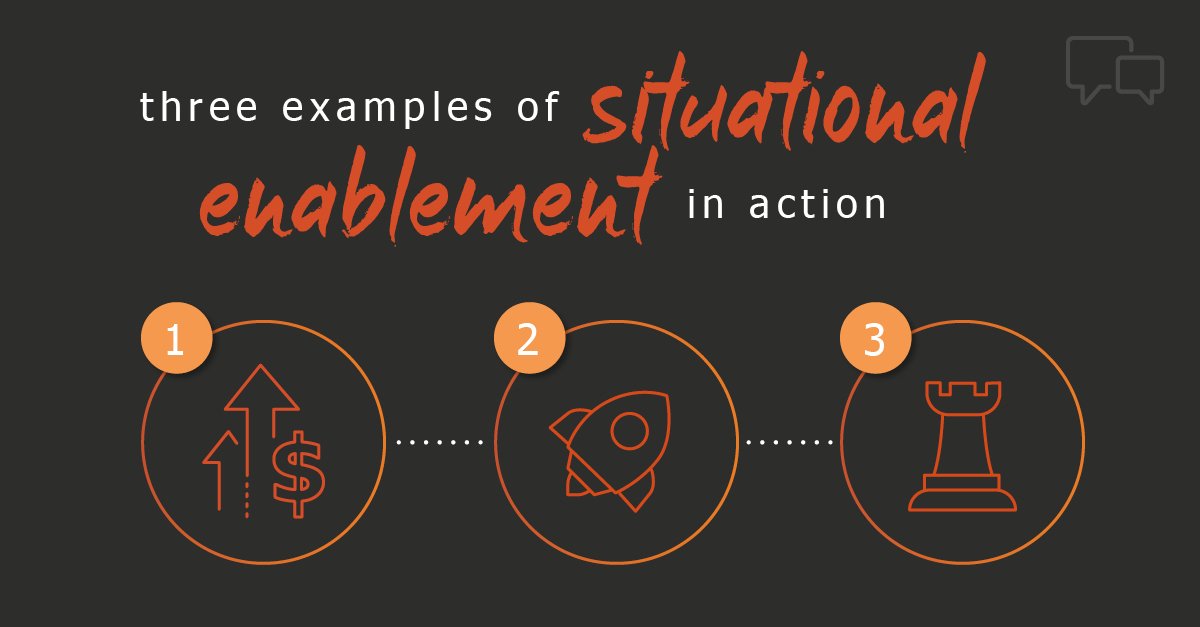
This article describes three examples of Situational Enablement in action.
What is Situational Enablement?
Situational Enablement programs are flexible and responsive sales enablement initiatives you can roll out to quickly address must-win business challenges and market opportunities.
At the core of Situational Enablement is the integration of tailored messaging, content assets, and relevant skills training to respond in weeks (not months) and win at that moment. Consider these three examples.
1. Communicate a Price Increase
At the beginning of the year, one company decided to increase the price of their services—an initiative that would account for seven percent of their growth for the year. To make it happen, they needed to train about 6,000 sellers to deliver that price increase message to their customers.
The Solution
Message: A message specifically designed to persuade customers to pay more without disrupting the relationship so much that they start to shop around. The message was based on an exclusive, tested, and proven framework for communicating price increases.
Content: A “Why Pay More” call guide was created to provide structure for the conversation. It also included sample email and voicemail messaging content, along with potential questions, objections, and responses.
Training: Micro-training videos were embedded to reinforce key concepts from the company’s popular negotiation skills training. These one-minute knowledge refreshers were linked to the moments in the messaging they specifically supported.
Delivery Timeline: Four weeks from concept to rollout.
2. New Product Launch
A company was poised to release a highly innovative product to the market. The rollout time on the unique offering would typically take a year or more to reach all 10,000 sellers. But they identified a small, 90-day window before the competition would be able to replicate the same service, so it was imperative to launch as quickly as possible.
The Solution
Message: A disruptive and differentiated product launch story was designed to grab prospects’ attention, convince them to change to the new service, and create a clear contrast from the competing alternative. The message was based on an exclusive, tested framework.
Content: A teaser video, sales presentation deck, and call guide were created to help generate demand for a meeting and enable the first call and follow-up.
Training: The message was incorporated into an online training experience focused on skills for disruption and differentiation. It also incorporated an online mission where salespeople had to record themselves delivering the new product message using the skills to demonstrate proficiency.
Delivery Timeline: Six weeks from concept to rollout.
3. Respond to a Competitive Move
One company discovered that top executives from their biggest competitor were aggressively targeting their best accounts. This competitor was hosting executive-level meetings with existing customers to actively derail the relationship. The company needed to immediately respond and ward off this urgent competitive threat.
The Solution
Message: An executive-level, retention-focused message was designed to protect and grow the business with senior decision-makers at key customers. The message was based on an exclusive, tested framework for elevating the conversation to the c-suite.
Content: A detailed “Defend and Expand” messaging document provided the essential talk tracks, including example messages to gain access, presentation and conversational content, as well as objection handling responses.
Training: Micro-training videos focused on key executive conversation techniques were embedded in the document to provide both the story and skills training. A virtual training session, including role-play rehearsal, was conducted and recorded to prep the sales team for making the executive calls.
Delivery Timeline: Three weeks from concept to rollout.
Urgent Needs Require an Urgent Response
In this blog series, I’m giving you more details on what it looks like to execute Situational Sales Enablement at your company.
Watch our on-demand webinar , The Power of Situational Enablement, to learn more about this new model for training and enabling your team.
Read the other articles in the series:
- Winning the Moment with Just-In-Time Situational Sales Enablement
- The Three Waves of Sales Enablement
Next up: Enabling the Deficit Learner.
Related Posts:
October 27, 2026 /
Sales Enablement
Five revenue leaders explain how to scale enablement, prove impact, use AI agents, sharpen human skills, and create better customer experiences.
October 13, 2026 /
Sales Enablement
Deficit Learning is the principle that sellers learn best when they face an immediate, undeniable gap. This article explains the framework, the three types of sales deficits, and how to build a program designed around the moment of need.
March 16, 2026 /
Sales Enablement
Buying behavior has changed faster than much of the sales training world has kept up. See if your program needs a refresh with these five signals.
About the Author

Tim Riesterer
Tim Riesterer, Chief Strategy Officer at Corporate Visions, is the sought after expert on evidence-based revenue growth using counterintuitive approaches. Known for his candid thought leadership and engaging keynotes, he’s spent decades testing and refining go-to-market strategies that put buyers squarely at the center. Tim is the author of four insightful books, including Customer Message Management, Conversations that Win the Complex Sale, The Three Value Conversations, and The Expansion Sale.